
AI & Agents · AI ERP & SaaS · Security & Compliance
Hybrid AI for Salesforce: Claude, ChatGPT & Private LLMs, One Router
By David Gadyan · Published · Updated
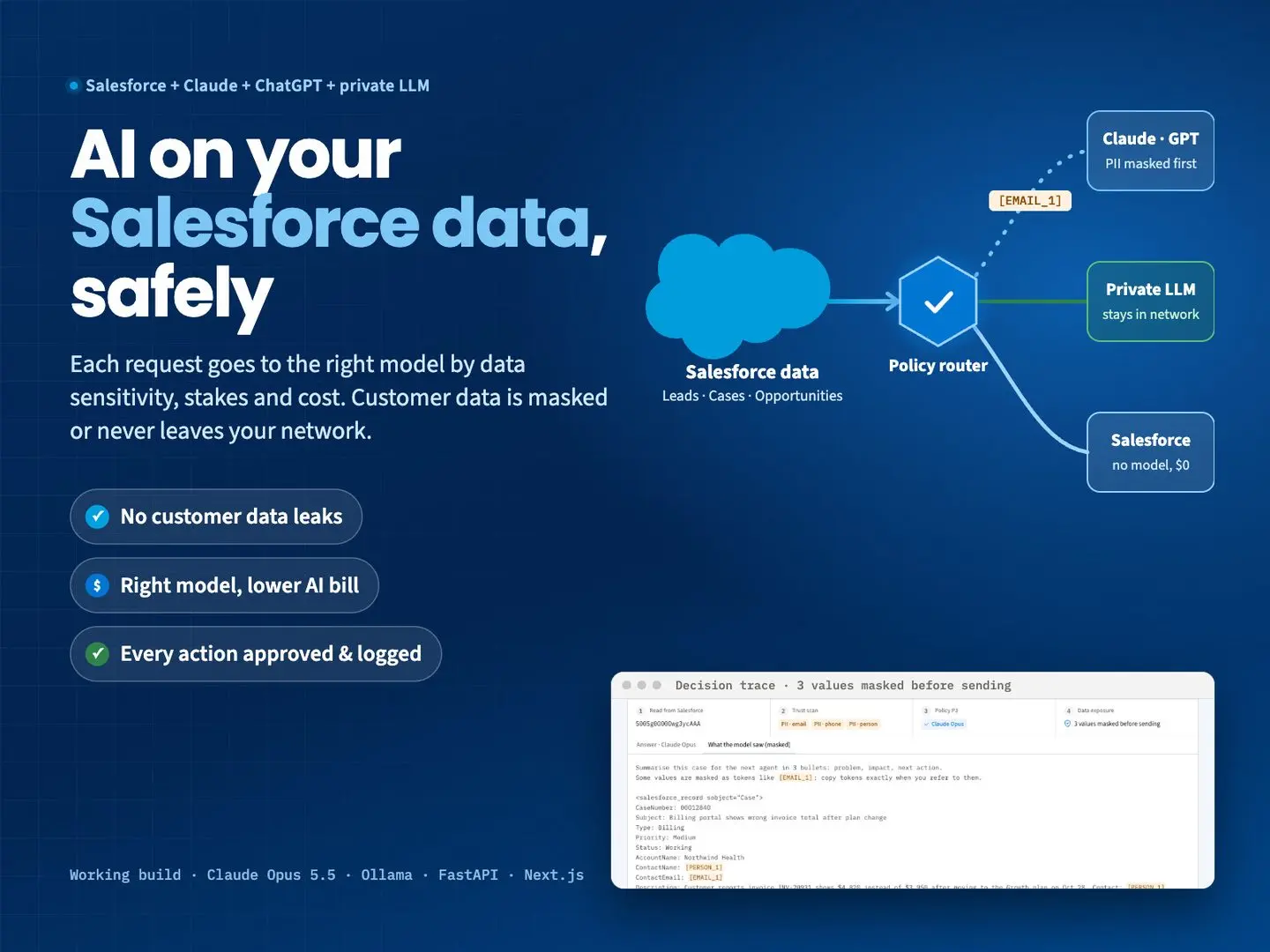
SF Ops Copilot lets a team use AI on Salesforce data without moving off Salesforce, overpaying for one model or leaking customer data. A policy router sends each request to Salesforce itself, Claude, ChatGPT or a private LLM in the company's network by sensitivity, stakes and cost, and masks PII before anything leaves. On top of it: Apex and Flow review that returns fixed code and a bulk test class, a revenue agent that works dormant leads with fact-checked drafts, and a sandbox refresh and migration planner. Nothing is written to Salesforce until a person approves it, and every AI decision is logged with tokens and cost.
The problem
Teams hiring for Salesforce and AI work describe the same five problems: "we want AI on our CRM data, but it can't leak"; "AI is getting expensive and we're locked into one vendor"; "our team ships Apex and Flows written with AI, and it breaks in production"; "we have thousands of old leads nobody works"; and "sandbox refreshes and org migrations eat days of admin time". SF Ops Copilot answers each one with something working, in one app, with Salesforce kept as the system of record.
The product in use
What I built
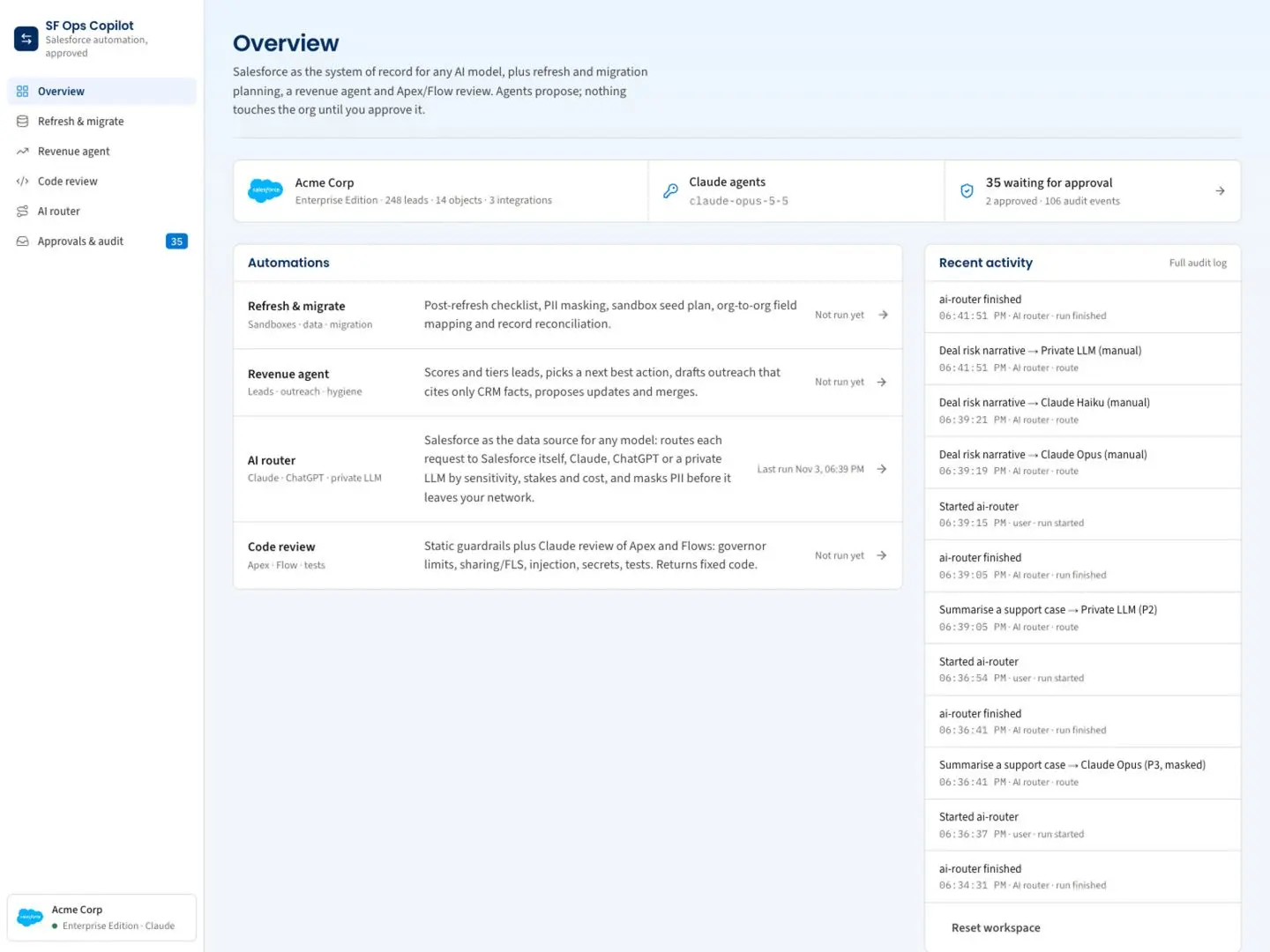
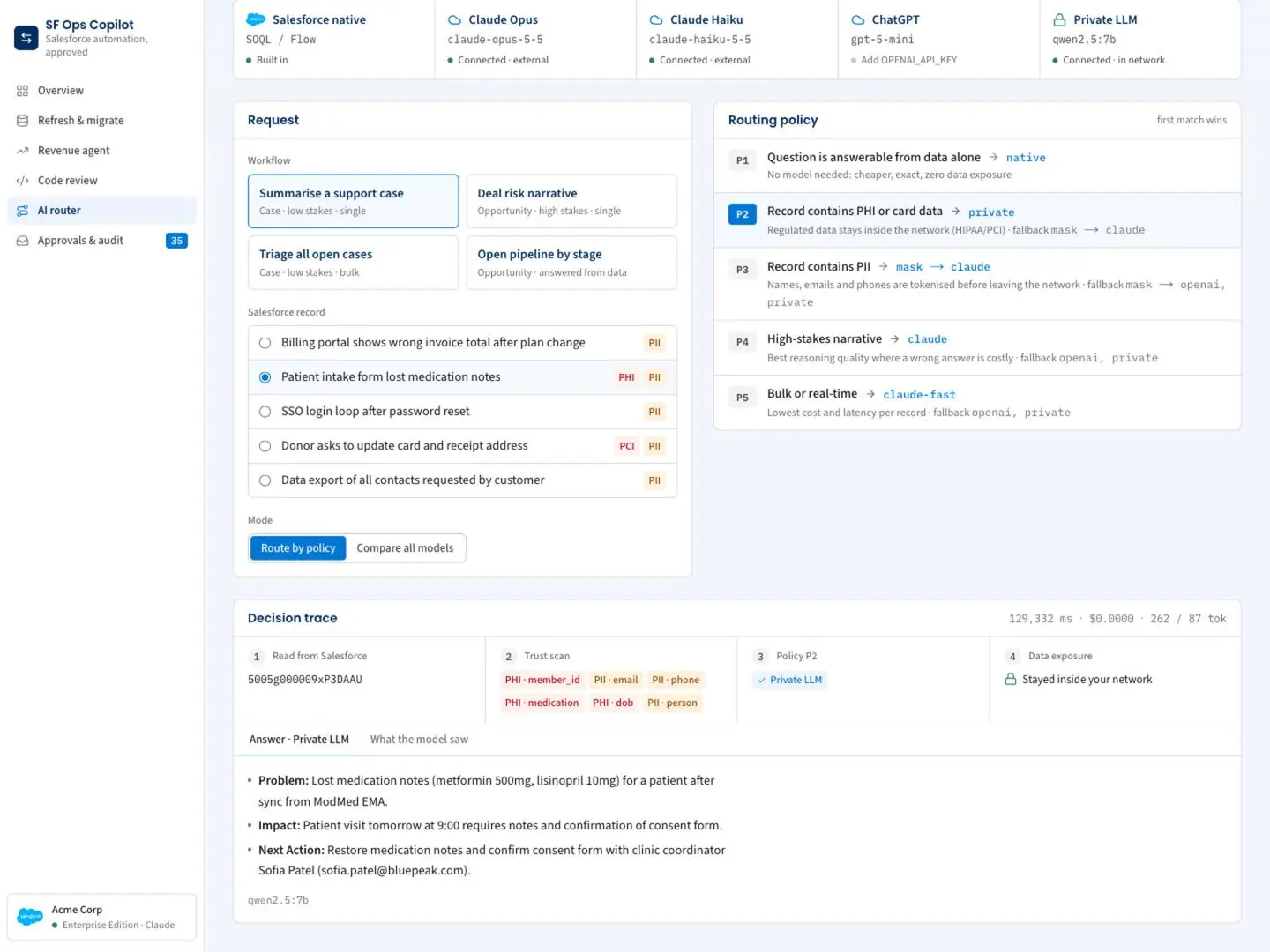
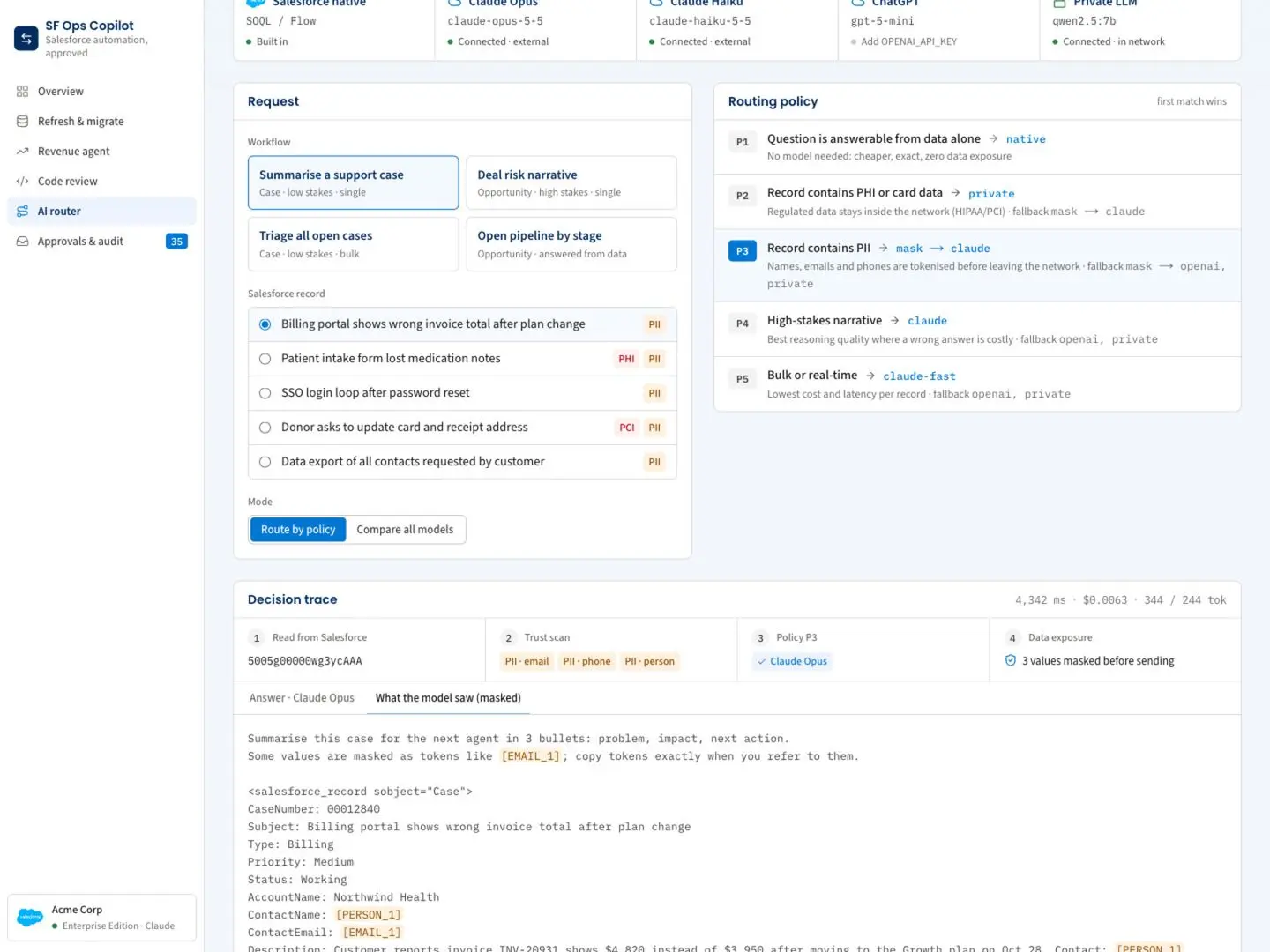
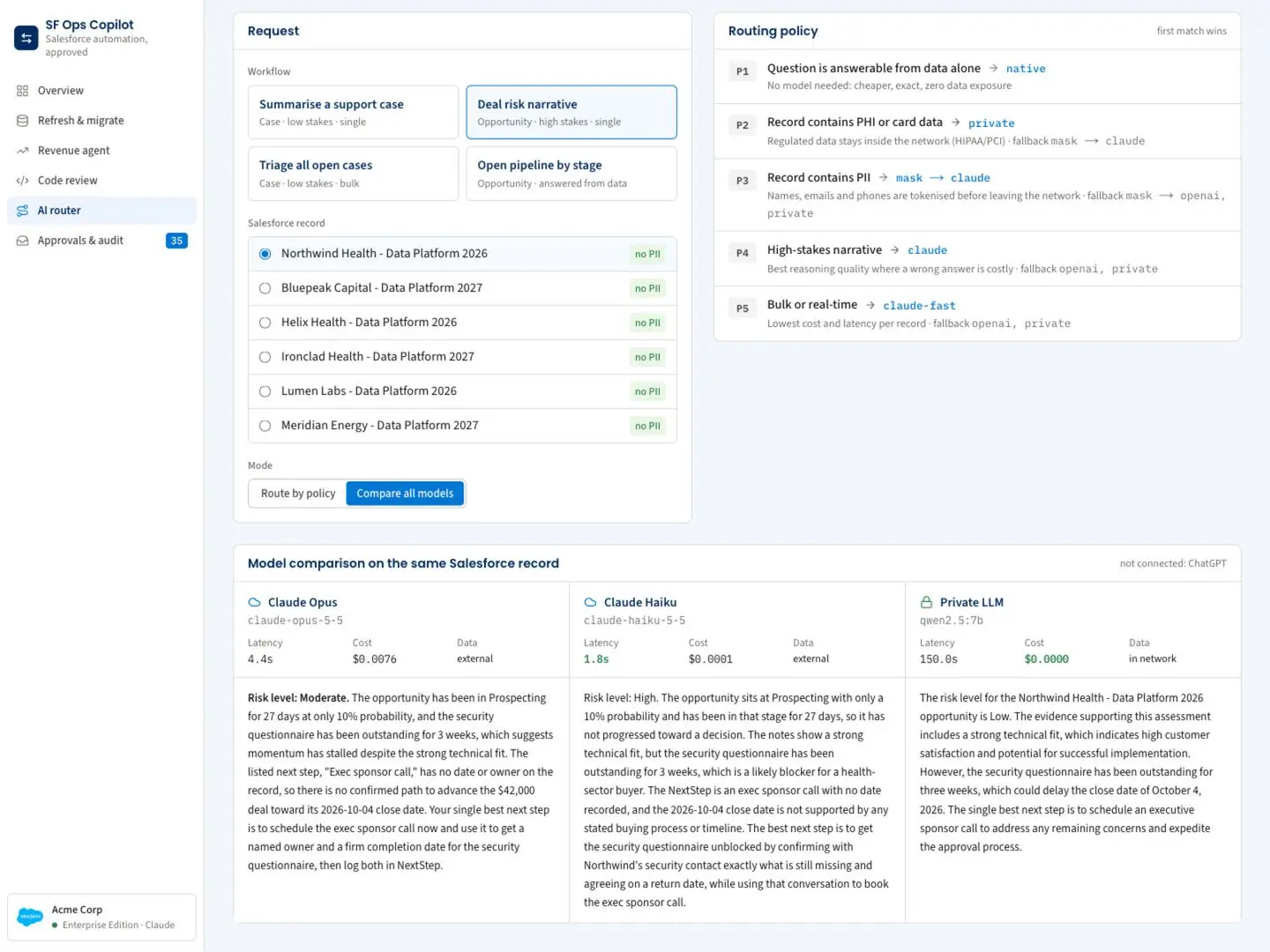
AI router. Salesforce becomes the data source for any model. Each request is routed by policy to Salesforce itself (a SOQL answer, no model, $0), Claude Opus, Claude Haiku, ChatGPT or a private LLM in the company's network (Ollama or vLLM), chosen by sensitivity, stakes and cost. The trust layer finds PII, PHI and PCI in every record: medical and card data goes only to the in-network model; names, e-mails and phones are replaced with tokens before any outside model sees them and restored in the answer. Providers that are down are skipped with a fallback, and a compare mode runs one record across every connected model, so the routing choice rests on the team's own data. Adding or swapping a provider is a setting, not a rebuild.
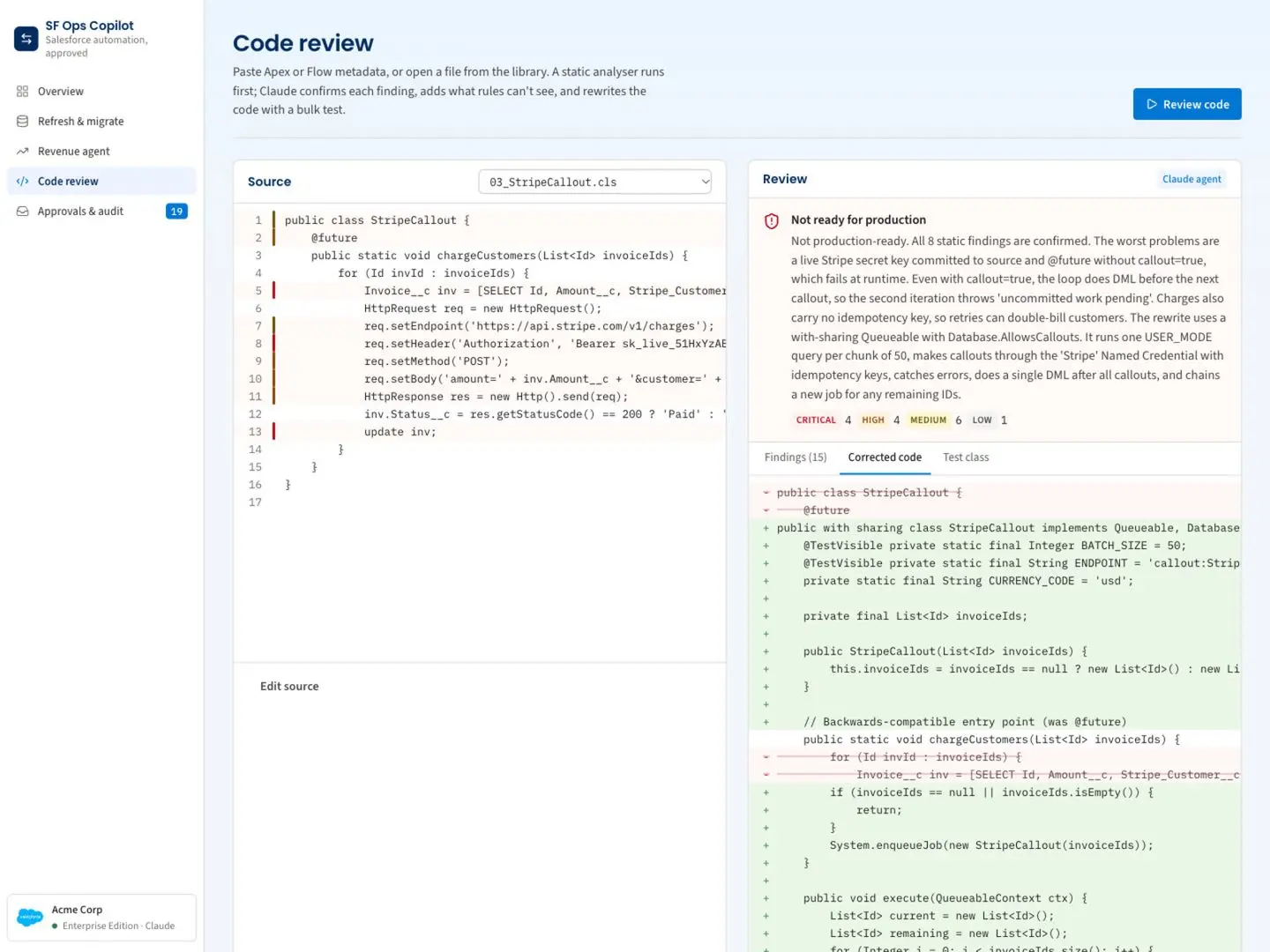
Code review. AI-written Salesforce code often looks fine and fails at scale: queries inside loops, missing sharing and field-level security, hard-coded IDs and keys. Every Apex class and Flow is checked by deterministic rules first (SOQL, DML and callouts in loops, sharing, FLS, injection, hard-coded IDs and secrets, test quality), then Claude confirms each finding, adds the ones rules cannot see and returns corrected code plus a bulk test class. On one sample payment class the rules found 8 issues and Claude found 4 more, including a callout-after-DML error that stops the job after the first record.
Revenue agent. A Claude tool-use agent scores and tiers each dormant lead, picks a next best action and drafts a short, specific e-mail. Every fact in a draft is checked against the record, and drafts citing anything that is not in the CRM go back to the model for a rewrite. A duplicate scan proposes merges. Nothing is sent or updated until a person approves it.
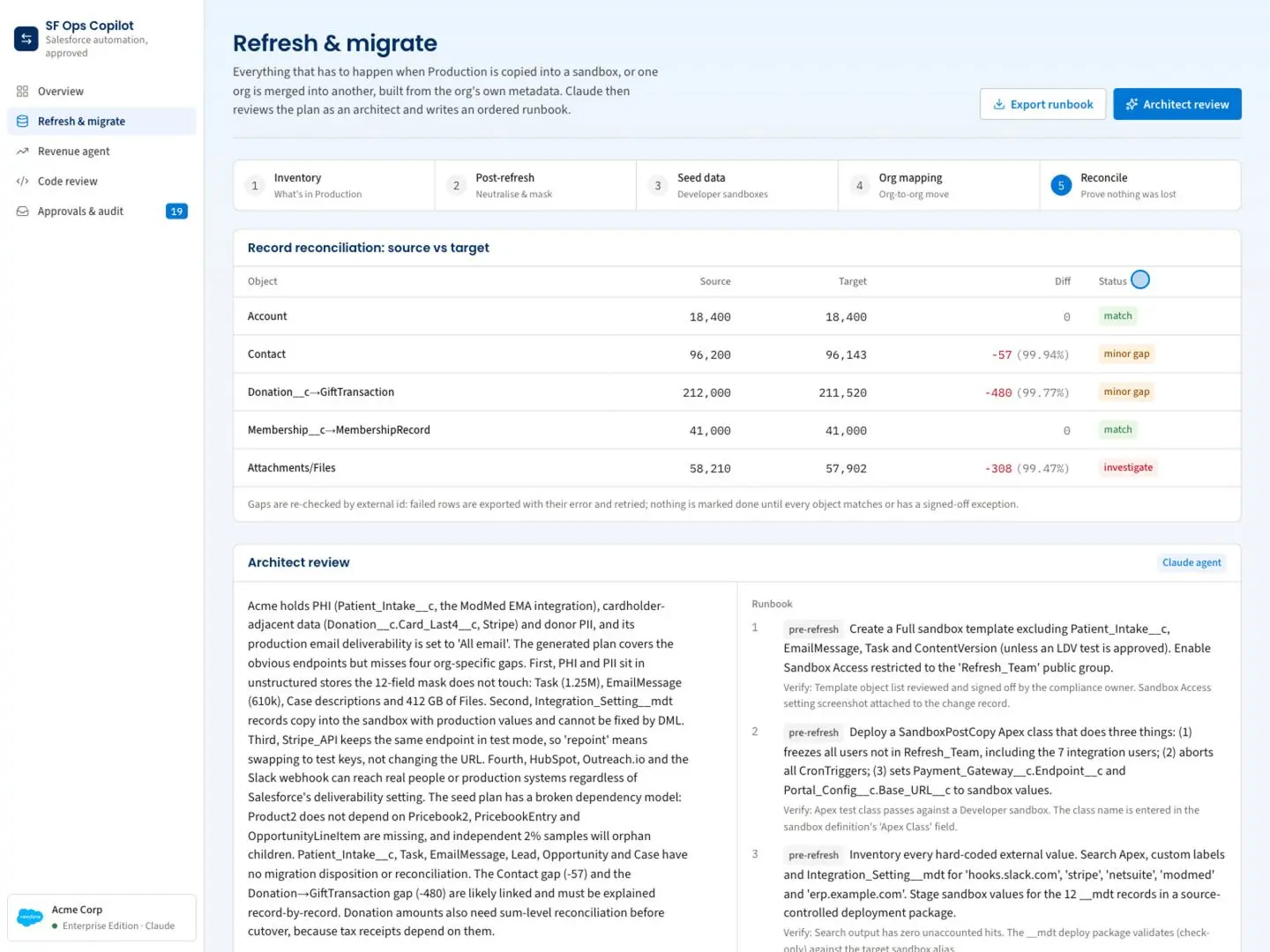
Refresh and migrate. After a sandbox refresh someone has to mask personal data, point integrations at test endpoints, stop scheduled jobs and reload test data, usually from memory. The planner inventories the org and builds that checklist from its own metadata, orders the data seeding so lookups resolve, maps fields for an org-to-org move and reconciles record counts; Claude reviews the plan as an architect and writes the ordered runbook.
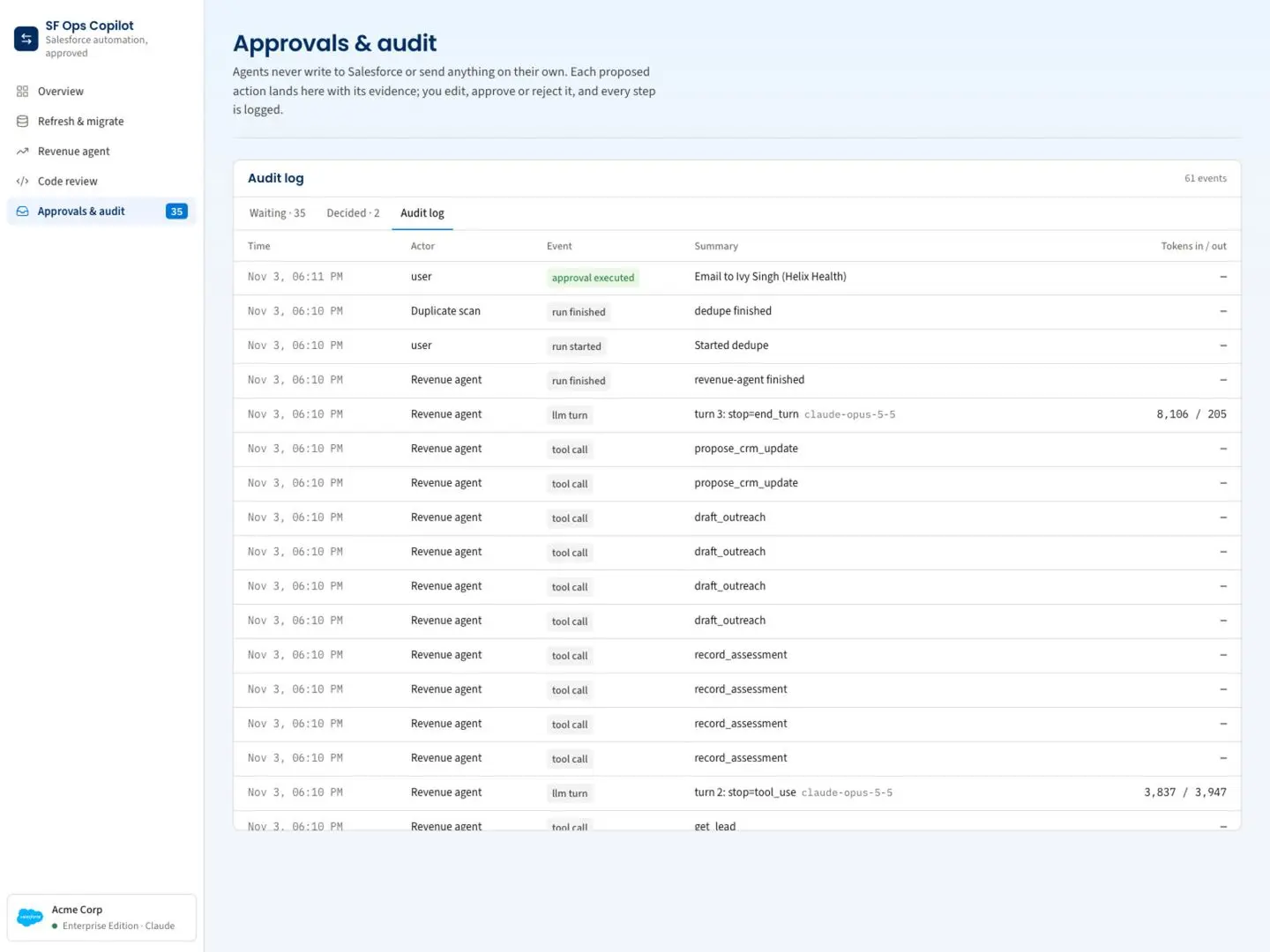
Approvals and audit. Agents cannot write to Salesforce or send anything. Each proposed action waits in the approvals queue, editable, and every run, model call, tool call and decision is logged with its tokens and cost. In demo mode sends and merges are simulated; in live mode approved updates PATCH the record over the REST API.
Architecture
Next.js 15 with Tailwind in front of a FastAPI backend: agents (refresh, the revenue tool loop, code review), the router (providers, trust layer, policy engine with fallback and benchmark), the rules engine (Apex checks, dedupe, scoring, refresh), connectors (the seeded demo org or a live org over the REST and Tooling APIs) and a core with the Anthropic SDK client and a SQLite store for runs, audit and approvals. Claude Opus 5.5 answers with structured outputs (Pydantic to strict JSON schema) in an append-only tool loop with strict tools and prompt-cached system prompts; every call is audited with token counts and cost. It runs with no keys at all on the demo org, takes an Anthropic key for the agents, Salesforce credentials for a live org, and any OpenAI-compatible endpoint for the private model.
Related projects
Virgil.ai: Agentic Health-Insurance Assistant
AI & Agents · AI ERP & SaaS · Cloud, DevOps & LLMOps · Security & Compliance
Private AI Gateway: Secure, Self-Hosted LLM Access for Every Team
AI & Agents · Security & Compliance · Cloud, DevOps & LLMOps
AI Jobs MCP: Remote MCP Server with Google OAuth on AWS Lambda
AI & Agents · Cloud, DevOps & LLMOps · Security & Compliance